


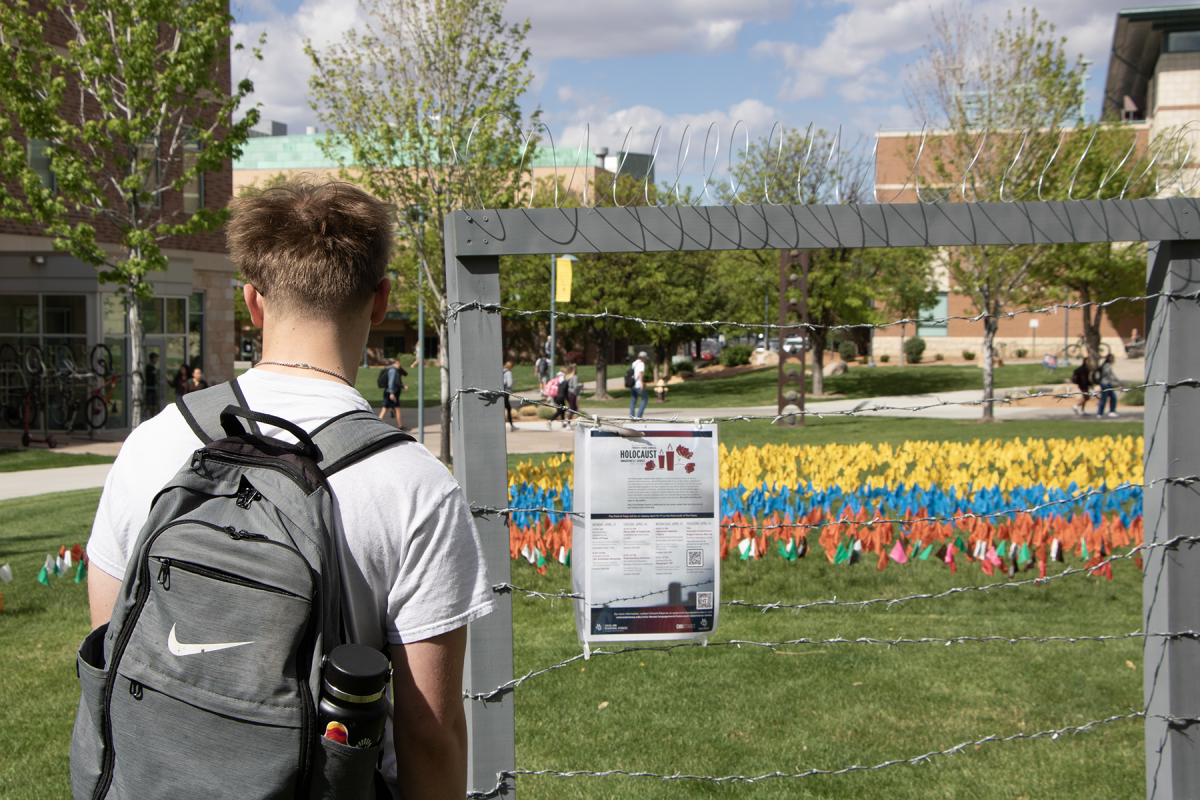
The Holocaust Awareness Series kicked off today with a moment of silence in front of the Field of Flags next to the Plaza. Each flag represents 5,000 lives lost. Professor of History Dr. Vincent Patarino addressed a crowd of people about the ills of genocide and connected the devestation that occurred almost 100 years ago to modern issues.
He read a passage from a book written by Ben Lesser, a child-survivor of the Holocaust. It was about a fake deportation event that Nazi-Germany staged in Poland to assuage world media about the conditions that Jewish people were living in at the time. The people were rounded up for photos and then once the event was over, the captives were robbed and chased off by soldiers. This was to draw attention to issues with ICE in the US.
“What I read from Ben Lesser’s book–what does that sound like today? Does it sound like, you know, people who like to wear masks and put people into semi-concentration camps?” Patarino said after the moment of silence.
This week-long event has many opportunities to engage with the theme of modern genocide and the rise of facism around the globe. All events for the 23rd installation of the Holocaust Awareness Series are free and open to the public.
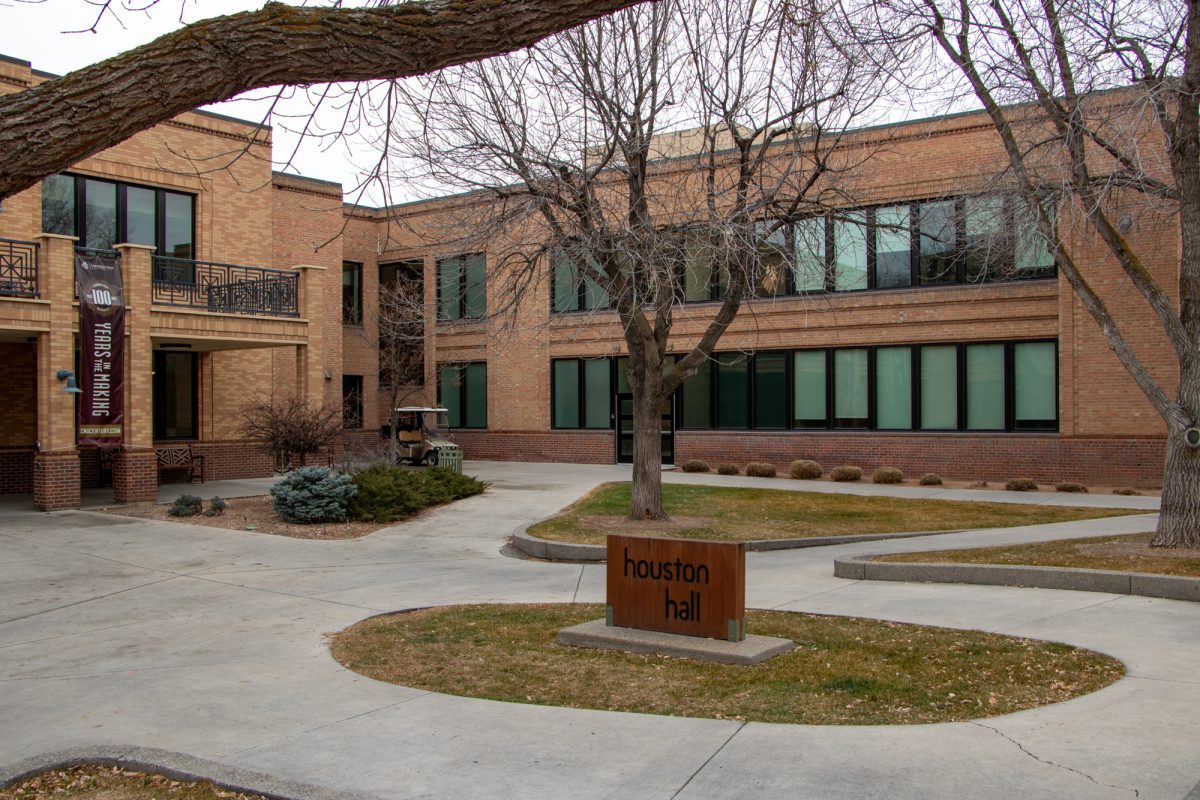
Monday from 6:30 p.m. to 8:00 p.m., Patarino is screening “The Armenian Genocide” in Houston Hall room 205. This film addresses what happens when a nation does not admit to committing genocide.
Freshman nursing major Sydney Peterson attended the moment of silence and said that more people need to talk about the Holocaust, especially online, to keep its legacy strong.
“I feel like we should pick up and talk more about the Holocaust,” Peterson said. “The earlier generations are always on technology. I feel like if we express the Holocaust a certain way on technology, the next generation will know how powerful and how devastating this time was in our history.”
On Tuesday from 4:30 p.m. to 6:30 p.m., Associate Professor of English Dan Rosenburg will present on Holocaust survivor and poet Paul Celan’s works. Then, from 6:30 p.m. to 8:00 p.m., Professor of English Barry Laga will give a presentation on the importance of memorials. “There is a danger in not representing the Holocaust” and Laga will go through the design, impact and function of memorials and monuments throughout history to now.
Patarino made a connection to the recent defeat of Hungarian alt-right president Viktor Orbán. He said Peter Magyar’s victory is “a major moment” and something that gives him hope in his little corner of the world on campus.
“He was able to re-establish what it means ‘I am Hungarian.’” Patarino said. “The crowds that now developed, not only in Budapest, but in some of the other major cities were mainly made of young people.”
NPR said that 77.8% of registered voters turned out in that election in an article yesterday. This turnout was the biggest since the Iron Curtain Fell in the 80s. Patarino said it was a rejection of nationalism, specifically “grievance nationalism” that Orbán’s regime used to normalize the dehumanization of marginalized groups like migrants, the LGBTQ+ community and others.
On Wednesday, from 4:30 p.m. to 6:00 p.m. in Houston Hall 205, Lecturer of Archaeology and Japanese James Coburn will present on the “Japanese Imperial Legacy.” He takes a deep dive into the colonial period on Korea and the cultural impacts of “cultural genocide that the Japanese committed on the Joseon (Korean) people.” Following that at 6:30 p.m. til 8:00 p.m., the CMU History Club and Phi Alpha Theta Honors Society is giving a screening “Paragraph 175” about the treatment of the queer community by Nazi Germany.
Patarino said that it’s easy to fall into a “never again” narrative about genocide but it’s still present today.
“The problem is, it has happened again and it’s happened over and over,” Patarino said. “There’s genocide still going on in the Sudan. There’s some going on in East Asia. There are debates right now about whether or not Palestine can be considered a genocide. We’re too close to it I think right now.”
He said this is because facism isn’t dead and it hasn’t really ever gone away. The Holocaust Awareness Series is an opportunity to learn more about the ways fascism still persists. Patarino thinks education and awareness about these topics is a part of activism against it because it allows people to see fascism and modern genocide more clearly.
The final event of the series will be held on Thursday April 16. The keynote presentation is “The Project Heroes Rise Up: The Heroes Independent Concert.” Israeli musicians on stage use music and visual storytelling to discuss Jewish heroes across time. Time and place is to be determined. Tickets are free and can be reserved at the series website.




![According to club advisor Dr. Megan Wendler, “Math Club is meant to be a fun, welcoming community where people can come and learn some really cool things about math. [...] Every Spring, [Math Club] organizes a Math Extravaganza event"](https://thecrite.com/wp-content/uploads/2026/02/math.club-john.leet-3-E-web-1200x800.jpg)