

Correction: Zach McKay was identified as a senior anthropology major in the last print edition of the Criterion but is actually a junior history major.
Three teams represented CMU at this year’s Japan Cup in Denver. This quiz-bowl style competition, judged by native Japanese speakers tested the knowledge and skill of nine Mavericks on Japanese language and culture.
CMU has two Japanese language courses taught by outgoing lecturer James Coburn—Japanese I and Japanese II. Some of the schools they were competing against were high schools with Japanese classes and colleges with entire Japanese language majors. The top CMU team placed fourth out of 22 teams in their classification.
Junior history major Zach McKay said they came into the competition feeling a bit like an underdog but quickly realized just how prepared they were compared to other teams.
“We never felt like we’re getting blown out by any of the teams.” McKay said. “It was always very close and the fact that it’s very close means that at, a different day, like any given day, we could have won. And that’s also very encouraging for all of us, I think to know, that like, fingers crossed we go next year, then we have like a real shot at winning.”
McKay was on the fourth place team with anthropology sophomore Lance Glauer and concurrent Grand Junction High School concurrent freshman Tegwin Ferguson. The last time CMU took students to the Japan Cup was in 2022. Coburn said that team was a dark horse and surprised everyone by winning. Since Coburn is leaving at the end of the semester for a doctoral program in Tennessee, there won’t be a structured class for the students to practice their skills.
None of the students that competed are graduating and despite not having an instructor, they all said the competition fueled their passion and motivated them to try again next year. They have plans to form a club and fund raise to be able to go next year.
“We definitely made an impression of, like, CMU’s ability to get stuff done for having, you know, a one-person Japan-Japanese Department,” Glauer said.
Junior psychology major Tag Fortuna said he wished he had engaged in opportunities like this sooner in his college career.
“Early on in college, all I cared about was just getting good grades,” Fortuna said. “I’m realizing kind of, the value of participating in more, kind of, competitions and other things like this. Even if my GPA goes down a couple points, like, I think it’s totally worth it to be a part of stuff like this.”
He said when he studied abroad in Japan he didn’t know anything about the language or culture. He tried to order a quarter pounder at a McDonald’s in Japan and didn’t know how and got so embarrassed he cried after. This past Saturday, he won the conversational round.
“Language learning is irritating,” Fortuna said. “It doesn’t always feel like you’re getting better but after a while, you can finally start to see the fruits of your labor and it feels so freaking good.”
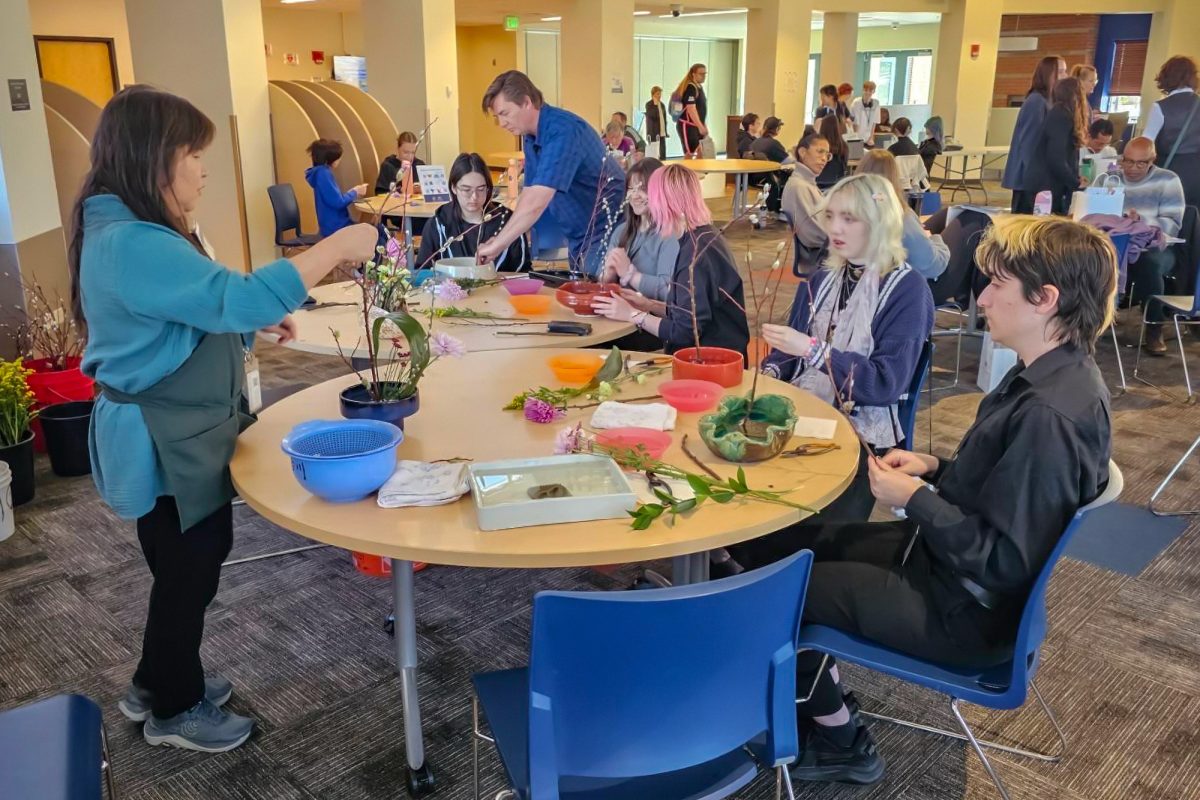
Japan Cup also included workshops hosted by native speakers. Glauer said one of his highlights was the opportunity to try ikebana—a Japanese flower arranging art form. It emphasizes asymmetry and minimalism.
“It was nice getting to hear them, like, talk in native Japanese,” Glauer said. “It kind of helped me get the tone and rhythm of how it’s meant to be spoken.”
The competitors were served a traditional bento for lunch. Junior finance major Juan Trevino said he was initially motivated to participate in the competition because of the food. However, when it came time for him and Ferguson to eat lunch, they were scheduled to compete in the conversational round.
“Our conversation thing is about the start and I see, like, all the bento coming out and I’m like ‘oh those smell so good. It looks like so good,’” Trevino said. “Come back from the conversation round, all they have was, like, maybe 10 vegetarian options left and I was just so upset.”
Trevino said he spent most of his time learning Japanese proverbs and idioms. Between cramming and bonding, his competition partner, senior music major Rob Reid, came up with his own proverb. Trevino and Reid’s team came in seventh overall.
“I decided to make one almost as a meme at first but it came out kind of dope,” Reid wrote. It almost translates to “you don’t see monkeys in the snow” which he said means “be the change you want to see in the world.