


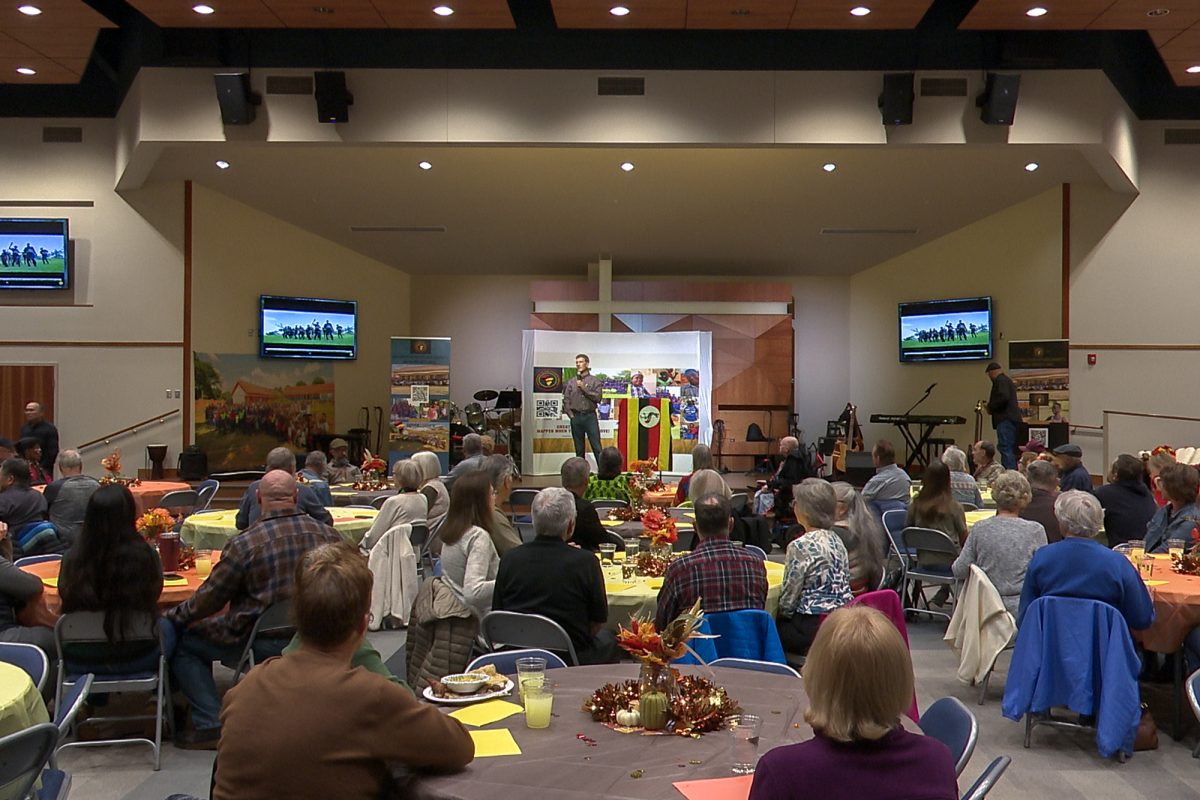
The scent of curry and fried pastry drifted through the fellowship hall at First Presbyterian Church as plates of rice, chicken and sambusa made their way down 28 tightly packed tables. For the 10th year in a row, Mathias Mulumba turned an ordinary November evening into an African Thanksgiving Dinner — and this year, it doubled as his birthday party.
The dinner ran from 5 p.m. to about 7:30 p.m., and Mulumba estimated about 300 people cycled through the doors. The room stayed full as families rotated in and out while volunteers slipped between chairs with trays of food.
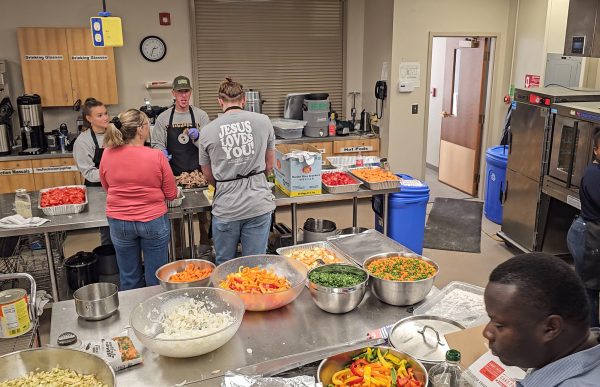
At the center of it all was the food itself, a spread rooted in Mulumba’s Ugandan upbringing. Volunteers started cooking with him early that morning, working huge pots of fragrant chicken curry brightened with turmeric and tomato, and mounds of pilau-style rice studded with peas, corn and carrots. Along one side of the serving line sat a pan of sambusa — crisp, triangular pastries stuffed with seasoned ground beef and onions — and a vegetable medley of carrots, onions, tomatoes and peppers simmered in a mild yellow sauce.
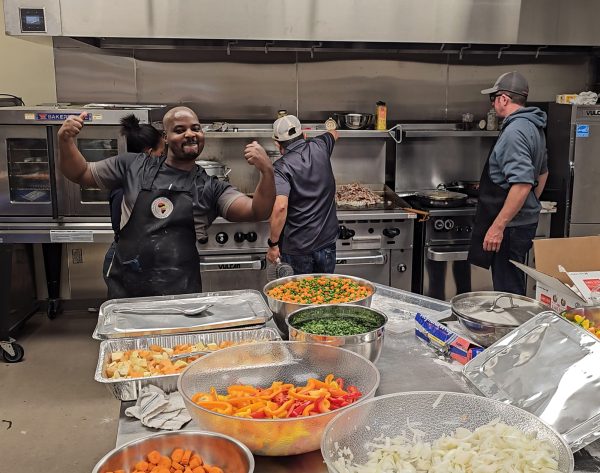
Rather than asking guests to stand in line, teams of mostly teenage volunteers — with a few adults mixed in — carried finished plates directly to each table. They moved in steady loops from the kitchen to the hall, setting full plates in front of guests and returning with refills or extra sambusa. Even people standing near the back of the room or along the walls found plates in their hands as servers continued bringing food out almost nonstop for the two-and-a-half hours the dinner was underway.
Near the entrance, Tatenda Mugwagwa, a regular at the dinner, lingered over the merchandise table piled with hand-carved wooden bowls.
“I’ve already got three bowls from Mathias the last couple times,” Mugwagwa said. “Two big bowls and then one little one.”
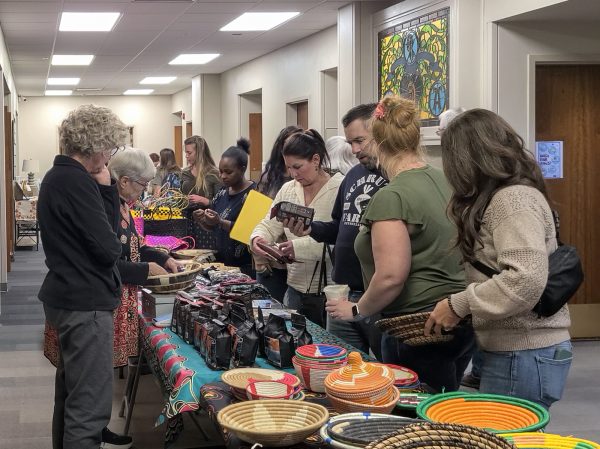
This year, the table also held bags of African coffee from the Father to the Fatherless campaign awards.
Those purchases add up. Mulumba’s nonprofit, Father to the Fatherless, supports a primary school, agriculture projects and vocational training in his home village in Uganda.
For some guests, the connection between the food on their plates and the work overseas felt personal.
“I own a studio here,” Mugwagwa said. “We run on coffee,” she added with a laugh, noting that supporting education in Uganda matters to her as a mother.
Nearby, Brian Bray sat with his children at one of the crowded tables.
“We’re the Bray family of seven that just got back from Uganda,” Bray said.
His wife, Brooke Bray, who described herself as “a homeschool mom and a stay home mom,” said sharing Ugandan food with their kids in Grand Junction helped them remember the faces and stories they had just visited.
On stage, Mulumba thanked the crowd for showing up — and made a point to thank his wife and daughters for standing with him as he balances life in Grand Junction with ministry work in East Africa. He reminded guests that the dinner is free every year and that donations go straight back into the school, farm and training programs overseas.
“I’m trying to break the cycles of poverty through education,” Mulumba said.
After the main course, volunteers brought out sheet cake and vanilla ice cream, and the room joined in singing “Happy Birthday” to Mulumba. It wasn’t a fancy dessert, but it fit the mood: simple, sweet and shared.
By the end of the night, the curry pots were scraped nearly clean, the sambusa tray sat empty and only a thin layer of rice clung to the last serving pan. The hand-carved bowls and bags of coffee had thinned out, too. What remained were clusters of people still talking at their tables.
For Mulumba, that’s the point of the evening — not just feeding people, but gathering them. The African Thanksgiving Dinner is his way of saying thank you to a community that has embraced him, his family and his work, one plate of food at a time.



![According to club advisor Dr. Megan Wendler, “Math Club is meant to be a fun, welcoming community where people can come and learn some really cool things about math. [...] Every Spring, [Math Club] organizes a Math Extravaganza event"](https://thecrite.com/wp-content/uploads/2026/02/math.club-john.leet-3-E-web-1200x800.jpg)