

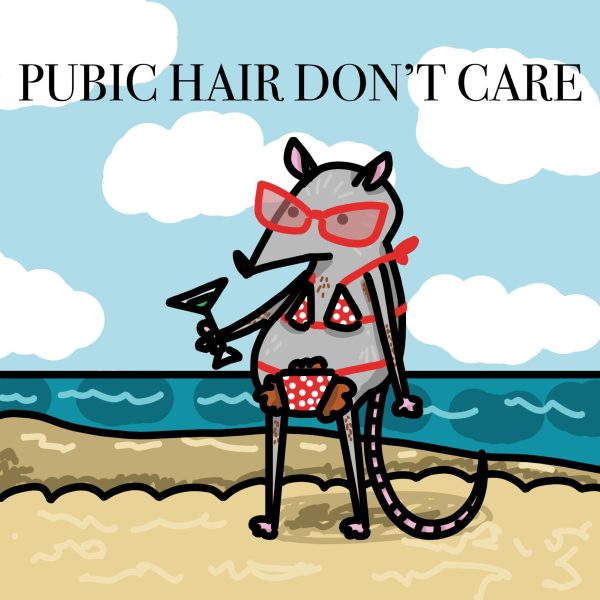
I have conflicting feelings about my body hair. On the one hand, I am the victim of a lifetime of social conditioning that instilled disdain and shame for it because it’s not feminine or it’s gross or it’s not attractive, so I remove it. On the other hand, my brain says “fuck that” and I let it grow long and only occasionally trim it out of respect for my husband’s dinner.
This tension is built on the back of centuries of hair removal practices that mostly women have endured. Women in ancient Egypt used sticky sugar to rip out their body hair and shells were sharpened to shave it off. In the US, Gillette patented its first razor in 1904 and body hair removal became associated with hygiene.
Removing body hair was an effective way to mitigate lice for people living in close quarters and it prevented bacteria build-up when showers weren’t as accessible as they are now. What this did was deepen the world’s obsession with infantilizing women.
In many ways, the world, and especially the US, encourages pedophilia and hair removal is a powerful aspect of that. In tandem with a male-centric, patriarchal society, it produces the social expectation for women who seek the attraction of men to cling to youth because youth is constructed as the foundation of beauty. Men, historically, define beauty standards for women.
Body hair removal also reinforces the gender binary and perpetuates a confined definition of what it means to be a woman, girl, or female. It’s also extremely violent. Waxing quite literally rips the hair out of the follicle and damages it over time. Shaving scrapes the top layer of hair and skin off and has a high likelihood for cuts. I’ve deeply wounded myself shaving many times and in very intimate places. Laser uses temperatures of over 100 degrees to burn the follicle and kill it, but it takes several painful rounds and even then it isn’t always permanent.
According to Fortune Business Insights, body hair removal was about a $4 billion dollar industry globally in 2025 and is expected to grow. How is the social expectation so powerful that not only do I subject myself to low-grade torture but millions of women do it every single day?
When I was younger, I remember begging my mom to let me start shaving my legs around age 11. She eventually caved and I got my first pack of razors just in time for sixth grade. I fumbled with the razor, nicked my skin and spent what felt like hours in the tub getting into every nook and cranny I could reach. As a good, red-blooded American female, I was faithful with my hair removal for years.
It wasn’t until I started living on my own and realized just how much my mom was spending on razors that I decided to take a more “bohemian” perspective. Then, I learned about the waste from disposable or single-use plastic and it really sealed the deal for me. I started letting it all grow.
I have never faced more direct judgment about my appearance from complete strangers than when I stopped removing my leg hair. Older women would ask me why my legs looked like that and teenage girls asked if I had bugs in my leg hair. Even my own mom, who didn’t want me to shave
in the first place expressed a degree of disgust. I spitefully doubled-down. In a way, not removing my body hair filled me with a sense of moral superiority and that shit hits better than most drugs.
That moral superiority was fueled by the idea that I wasn’t perpetuating my own infantilization. I refused to engage in this twisted idea that appearing child-like was how to enhance my attractiveness. However, on the inside, my anxiety was nagging at me just like my 11-year-old self to tear it all out.
In a perfect feminist world, people can do whatever they want to their bodies–including hair removal. It’s bodily autonomy. However, in that perfect feminist world, does the desire still exist? It’s hard to say.
Now that I’m a bit more removed from middle school and have walked through life as hairy as possible, I’ve found myself waffling somewhere in the middle.
On the one hand, I love the way my skin feels after it’s been freshly waxed (I refuse to shave–it’s not worth it). My tattoos look more clear, I get a more even tan and it satisfies the itchy part of my brain that likes things to be neat and orderly.
On the other hand, I love my body hair because it’s a part of me. It serves a biological function; it’s meant to be there. I shower regularly and don’t have to worry about lice like during the industrial era. My body hair is part of what makes me a human, a mammal, a living breathing thing with functioning hair follicles.
I struggle between asserting agency over my body–by both removing my hair and not–and being mindful about why body hair removal is so pervasive. I don’t want to contribute to the normalization of pedophilic tendencies, but I also don’t want to feel like I have to modify my behavior just because of some perverse social norm. The weight of the world rests on my wax lady’s shoulders.