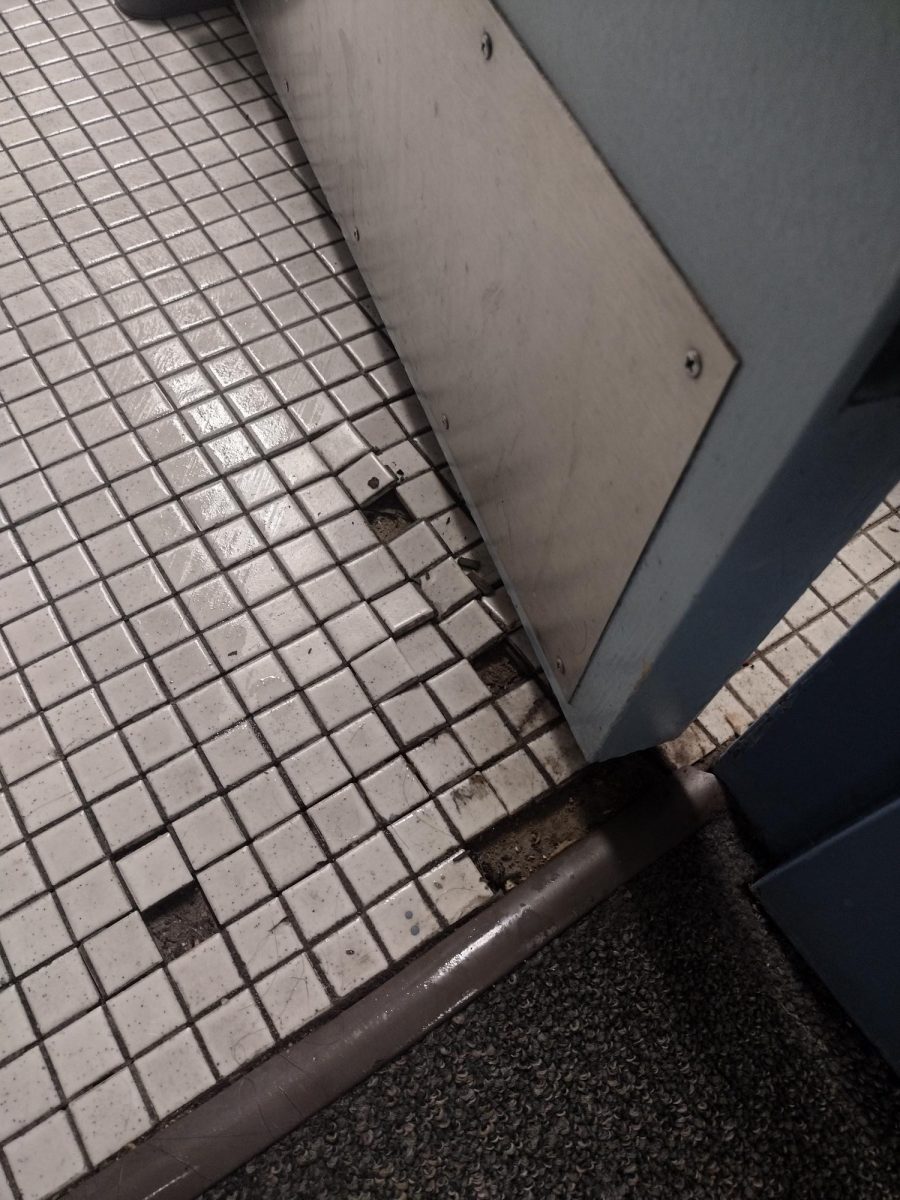



A water pipe in the geothermal loop in Escalante Hall burst on the evening of Friday, Nov. 7 at around 4:30 p.m. Local restoration company Rapid Response taped off the west wings of the first two floors for flood remediation and many classes needed to relocate.
The impacted classrooms will likely not be usable until after Thanksgiving Break, according to a department-wide email from the Department Head for Languages, Literature, and Mass Communications (LLMC) Tiffany Kinney.
Students headed to class in Escalante the following Monday saw signs on each of the closed floors that redirected them to their new classrooms. Professors cut classes that normally run 50 minutes or more, and many who did not receive a reassigned classroom were forced to improvise.
Sociology professor Dr. Stephen Merino, for example, canceled his class in Escalante altogether on Monday.
Mass communications professor Dr. Jesse Benn received no notice that the flooding impacted his classroom in room 125.
IT initially thought the Mac Lab, where Benn’s class meets was functional. However, after a closer inspection, they found that the Macs were unusable. The other Mac Lab in room 247 suffered damages as well.
Almost three hours after the flooding started, CMU contacted Rapid Response at around 7:30 p.m. on Friday.
Rapid Response Project Manager Aaron Manzaneres indicated that Escalante’s flooding is one of the biggest jobs he has ever worked on.
“The first day, we were here, Friday, til 3:30 in the morning,” Manzaneres said. “And then came back a few hours later at 9:00 [a.m.], worked all day Saturday, worked all day Sunday, worked all day Monday. It’s just been a lot.”
He estimated that it will end up costing over $100,000 for the flood remediation alone.
In an effort to dry the water damaged areas out quicker, CMU increased the temperature throughout the building. The rooms on the third floor were hot enough that professors found it more comfortable to take their classes elsewhere. Professor of Japanese James Coburn moved his class to the front stairs of Escalante due to the heat.
Coburn said the stairs were his second choice, as another class attempting to escape heat already occupied the third floor patio.
“Tuesday–Thursdays, I’m just dying now,” history major Kai Batcha said about the heat in her classes.
According to Vice President of Marketing and Communications David Ludlam, this leak occurred due to “hyper-friction” in the pipes of the geothermal system in Escalante. Water constantly moves through the pipes, and over time, that constant friction breaks down weaker points in the system such as pipe junctions.
Ludlam said that this is the third time the geo-loop has failed since the building opened in 2014.
According to an email to the LLMC department from Vice President of Facilities Kent Marsh, the damage was contained to the west side of the building. The offices in the Marketing and Communications department, including Ludlam’s, have avoided the flooding each time, as well as the production studio for CMU-TV.
Marsh wrote in that email that the damage does not require any significant construction efforts. Ceiling tiles and baseboards are the majority of what he said needs replaced However, construction can only occur once the ceiling tiles and baseboards have dried out and the remediation team leaves. He also noted that it “looks worse than it is, but will take time to dry out.”
Manzaneres said that some insulation and electrical equipment in the building will need to be replaced as well. When his team arrived on Friday, some floor outlets in affected rooms had smoke coming out of them.
Professors whose offices suffered damage were given the option to use Tomlinson Library study rooms until the end of Thanksgiving Break.
The Criterion reached out to Facilities for more information, but has not yet received a response.
![According to club advisor Dr. Megan Wendler, “Math Club is meant to be a fun, welcoming community where people can come and learn some really cool things about math. [...] Every Spring, [Math Club] organizes a Math Extravaganza event"](https://thecrite.com/wp-content/uploads/2026/02/math.club-john.leet-3-E-web-1200x800.jpg)