Transparency around staff and faculty salaries is not readily available at CMU according to Faculty Senate President Dr. Stephen Merino. He said he doesn’t know exactly how pay increases operate for faculty. A few years ago, the annual summer notice of his pay increase for a cost of living adjustment (COLA) didn’t arrive and he hasn’t seen one since.
In a faculty senate meeting from the beginning of the year, a COLA freeze was discussed, indicating a new plan for a 5-year review cycle was set to take its place instead. This review cycle split all the departments on campus evenly across each year in the cycle. For example, if the mathematics department was reviewed in 2025 for raises, then they would not be eligible for another review until 2030.
President John Marshall clarified the pay schedule confusion.
“It’s not exactly true that we don’t do COLA. We did it for years. We paused it to pivot to a different strategy for seven years for a real specific reason,” Marshall said.
He said that they will present an option to the Board of Trustees that will likely include maintain the five-year cycle as well as a flat COLA instead of a percentage. Marshall said that in the past, using a percentage created problems.
“Those across the board increases that were really helpful in elevating the entirety of campus, what they did, is they exacerbated specific inequities,” Marshall said.
This cycle does not include increases for moving up the tenure track, added responsibilities or bonus consideration.
In order to understand the state of pay at CMU, the Criterion requested the base salary of all full-time employees since 2020. This does not include part-time employees or adjunct teaching faculty.
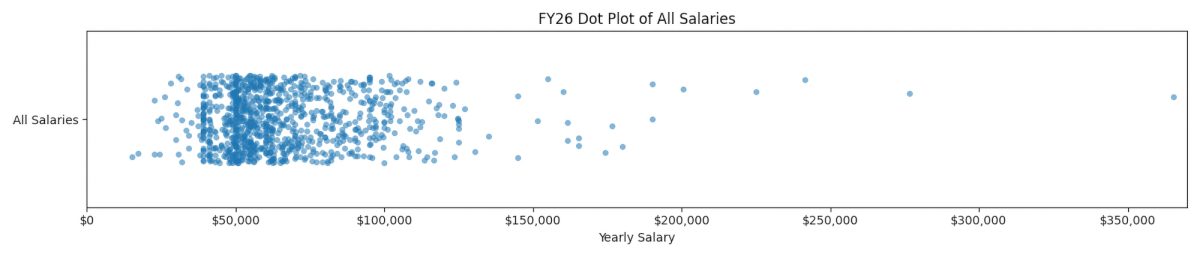
President John Marshall makes $365,300 per year as of fiscal year 2026. Relative to all other public university presidents in the state (not including community colleges), he is ranked 10 out 16. His pay sits between Colorado Mountain College’s President Dr. Matt Gianneschi at $355,350 and the University of Northern Colorado’s President Dr. Andrew Feinstein at $412,000.
He is one of two Colorado university presidents that does not hold a doctorate of some kind.
Marshall has received pay increases every year since taking over CMU from President Emeritus Tim Foster. He started at $325,000 in 2021. Foster left CMU after 17 years and made $450,000 in his final year.
The next highest paid person on campus is Senior Vice President for Finance and Administration Michelle Quinn at $276,500.
The highest paid teaching faculty is Professor of Physical Therapy (PT) and Program Director Dr. Christopher Carcia at $145,000. The top four highest paid faculty all work in the PT department.
According to the 2024-2025 Common Data Set, there are 371 full time instruction faculty at CMU, including its satellite campuses. Of the 371, 44 make over $100,000 and of that 44, 16 are either PT or occupational therapy (OT) faculty.
The dot plot pictured here demonstrates the scale of the base pay at CMU and includes all full time employees. Adjunct, contractors, part-time and students are not included. It ranges from $15,000 to $365,300. For clarification with the data, Quinn wrote:
“Pulling historical data together is a complex and manual process fraught with challenges and nuances. For example, individuals who are funded from multiple sources may have salary split between those sources, potentially creating the appearance of a total salary less than actual. We’ve used the most readily available data to respond to your request without spending tens of hours, but it certainly has limitations.”
Additionally, the first dataset sent to the Criterion was incomplete and did not include “full-time equivalent” calculations. The data also does not include positions with grant funding or fringe benefits like health insurance.