

Artificial Intelligence (AI) is rapidly changing the structure of academic standards at CMU. The world at large is currently experiencing the impacts of AI’s integration in day-to-day life. Many students have adopted AI as a part of their education. CMU faculty cannot ignore the presence of AI in the classroom either, and instructors vary in how they address it.
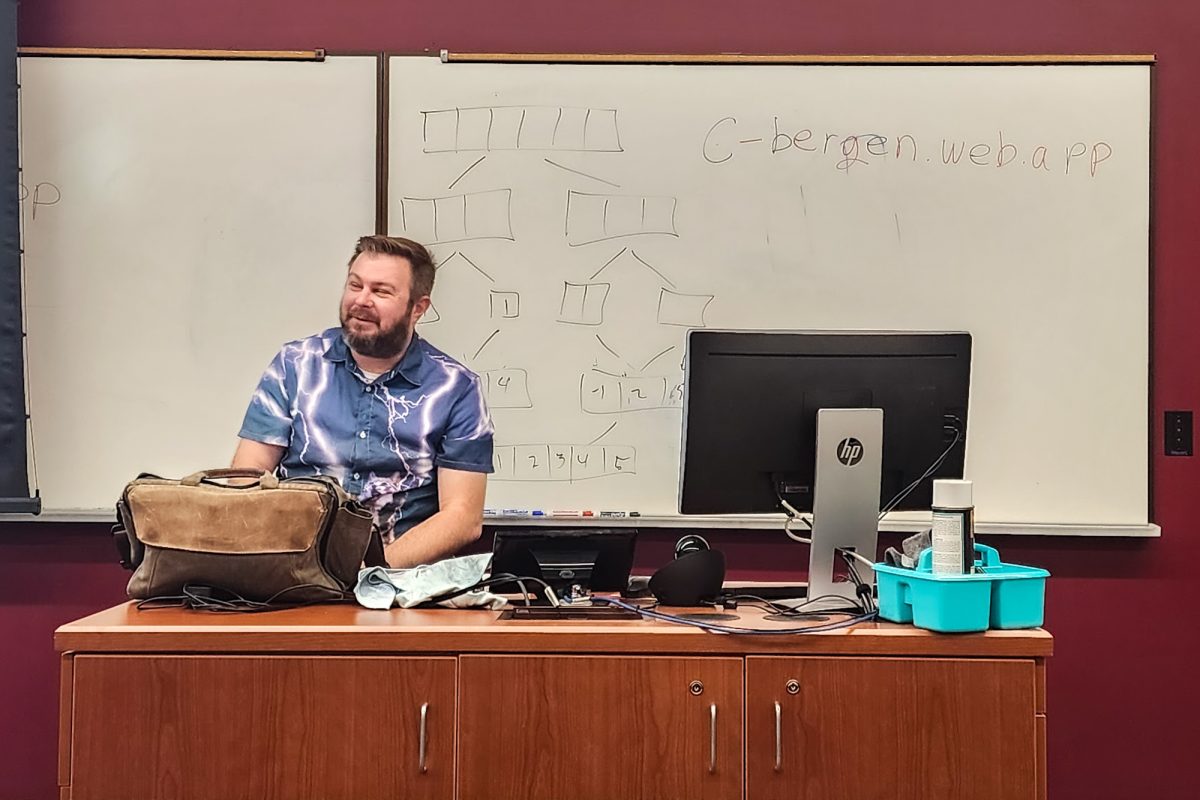
Assistant Professor of Computer Science Jeremy Bergen discussed how the presence of AI has impacted his experience as a professor.
“AI is like a really smart parrot,” Bergen said between bites of a breakfast burrito. Bergen wore a button up shirt of “Lord of the Rings” character Gandalf the Gray, standing in defiance of a giant flaming kitten-Balrog.
Bergen is in his eighth year of teaching computer science at CMU. On the third floor of Confluence Hall, Bergen sat in the middle of an office of scattered papers.
An unhung “Star Wars” movie poster leaned against a wall behind him. A collection of used fast food cups accumulated on his shrinking desk space. Unopened boxes lining the walls of his office have a secondary utility—extra surface area for more loose paper.
“AI is one of the great disrupters of the decade,” Bergen said.
Bergen addressed International Business Machines’ (IBM) Deep Blue project of the 1990s as a historic example of AI. IBM designed Deep Blue, a chess-playing computer, with the goal of defeating chess grandmasters. The supercomputer eventually triumphed over grandmaster Garry Kasparov after a six-game match in 1997.
“The problem was, Deep Blue was really, really good at chess and nothing else,” Bergen said. “They’re really good in a narrow domain.”
Bergen continued:
“Current AI systems are trying to be these general all purpose trades; they’re jack of all trades, master of none. They take in a massive amount of data, analyze it and then predict the next word,” Bergen said. “When you prompt it for something, it takes your input, stores it as a token, and then says: ‘This token data looks most similar to this token data.’ It’s a derivation of previous things.”
What would you say has changed with students since when you started teaching?
“Well, after COVID, everything changed and a lot of things went remote and online. This was before AI became more widespread. In academia, the question was ‘how can we deliver a high-quality course while maintaining academic integrity?’ Before AI, if you got stuck, you could Google it, you could talk to another person. They’d usually think alongside you and it invited a lot more collaboration and learning. When creating assignments, we’d make assignments that you couldn’t easily Google and just turn it in. You might be able to find code that was similar, but you needed to understand it on a deeper level to make it work. ChatGPT eliminated that.
It’s very much an arms race. It’s always been instructors trying to be one step ahead of students, and now it’s instructors needing to craft assignments to be AI resistant. There’s a number of ways that we do this, but the unfortunate thing is that anything we do as instructors, you can undo as students.”
Does this make you feel more adversarial towards students when grading?
“Oh, yeah. Definitely, we have to. I don’t want to be, believe me, but we have to.”
Where do you see Computer Science in five years?
“As much as I put down LLMs (language learning models), they aren’t going anywhere; they’re a useful tool for someone who understands the technology realm. I don’t see them being useful in the academic environment, not in the current state. Once you learn how to program, they can have some utility. I see a lot of layoffs in the industry that are getting blamed on AI. That’s true to some extent. There’s also a lot of COVID over-hires who are being let go, too. It just looks better to shareholders to blame AI.
I suspect that, in a few years, there will be a correction where they need to hire more people. They’re laying off junior developers in favor of senior developers. Senior developers, how do you become a senior developer? You start as a junior, and work your way up. As the senior developers start retiring or moving to other businesses, the companies are going to go ‘Well, we can’t keep up with this,’ and they’ll start hiring junior developers to fill that gap. AI won’t solve all the problems CEOs think it will.”
Finally, how will AI might make students foundationally weaker?
“When learning math, I had to work my way up through all the foundational math till I could use a calculator. Then when I knew my long division, my times tables, only then was I granted the ability to use [a] calculator. Much the same is true for AI. You can ask it to split strings for you. You can automate all the boring stuff, but all you’re doing is robbing yourself. […] College should teach you skills, but one of the most important things is you should learn how to learn.”