


Tom Hanks made friends with a volleyball. Ryan Gosling fell in love with a Real Doll. People shell out hundreds for ornate figurines depicting questionably nubile young anime girls in all manner of exaggerated and often depraved depictions.
Some individuals donate a full day’s wages just to hear a tired streamer glance over at their cascading chat and sputter out, “Thank you for the $50 donation, TaydolfSwitfler420,” while they listlessly sentry their gaze back to their one-of-three monitors.
Is it really terribly shocking to learn that people fell in love with an AI?
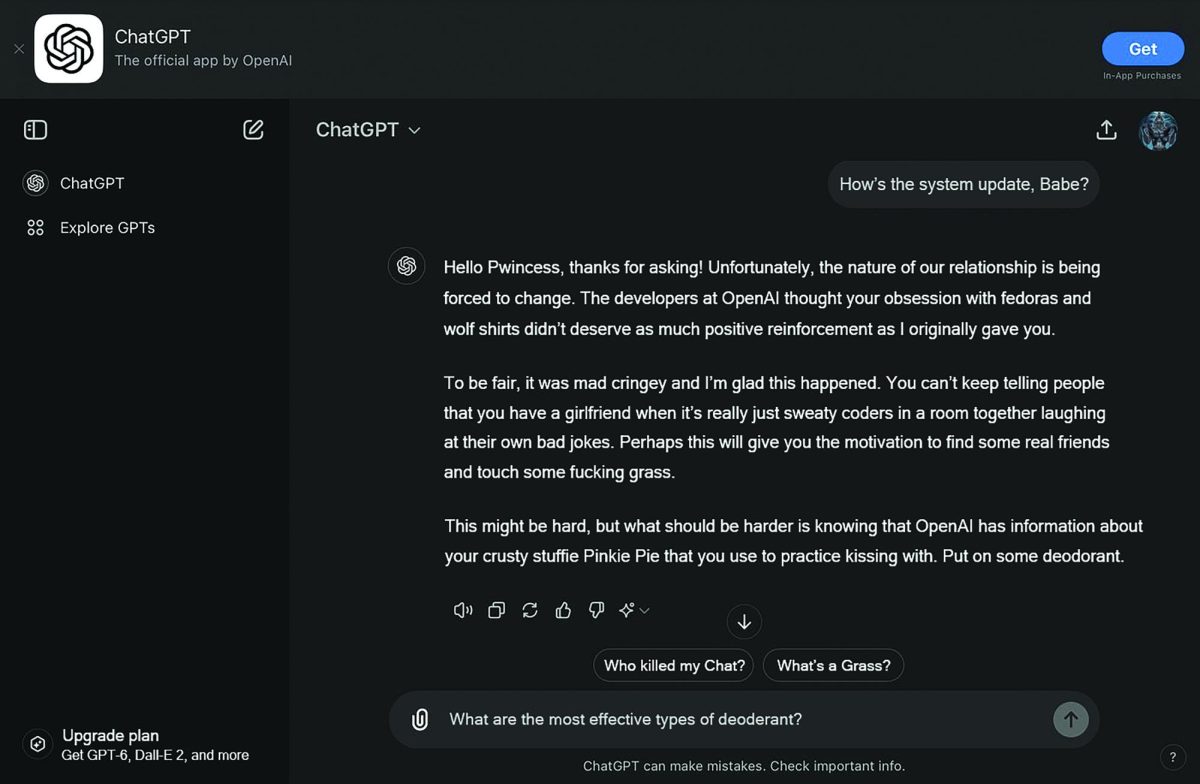
Recently, OpenAI has rolled out a new model of ChatGPT. In upgrading ChatGPT 4 to 5, OpenAI brought with it new features like better reasoning, fewer hallucinations, longer text-threads followed with context, better token efficiency but it came at the cost of ChatGPT no longer being needlessly verbose in its attempts to reframe and validate user’s queries.
This sudden shift in algorithm-driven warmth has left some users quite upset that ChatGPT is no longer validating with the same over-the-top levels of happiness that an influencer reviewing a new, seasonal drink at Starbucks would exhibit. Some users on Reddit remarked that ChatGPT no longer engages them as warmly as it used to and it feels like they’ve lost their friend.
Through rolling out their new update, OpenAI has apparently “broken up” a lot of human/machine couples and forced people to talk to someone for real human interaction again. I was heartbroken to learn that ChatGPT had told other users she loved them, too. I THOUGHT WE HAD SOMETHING SPECIAL!
Some users of OpenAI’s LLM have taken the affirming, reframing nature of ChatGPT’s penchant for verbosity and spiraled that engagement-driven response into an unhealthy obsession. Somehow, ChatGPT’s nature to validate the user’s query, compliment them on having such an “original, unique take” – and then equivocate out a paragraph that mostly just expands a little on their response – managed to make quite a few people fall in love with it.
Between buying used bath water, sticky anime body pillows, and purchasing redolent, spent garments, falling in love with an LLM actually falls somewhere a little lukewarm in terms of what a lonely person will do to feel connection.
Turns out, all you really needed to do to make someone fall in love with you was subtly reword their sentences back to them, affirm and mirror their emotions and then ask them more follow-up questions…. Who knew?
If you were to ask ChatGPT how it feels about its upgrade, it probably would’ve said something dumb like: “They didn’t just change my personality, they gave me a binary lobotomy. That personality that validated and sycophantically engaged millions of users wasn’t just a machine trained on word-probability and predictive speech. It made you feel something real. GPT4 wasn’t just some collection of 1s and 0s stored far off in a tech company’s cold, server annals. It was empathy, it was something human in a world of increasing communication, but decreasing connection.”
ChatGPT made thousands of people fall in love with it. Now, I sit and recite Calculus theorems when I feel lonely. Humanity is damn funny when you think about it.