

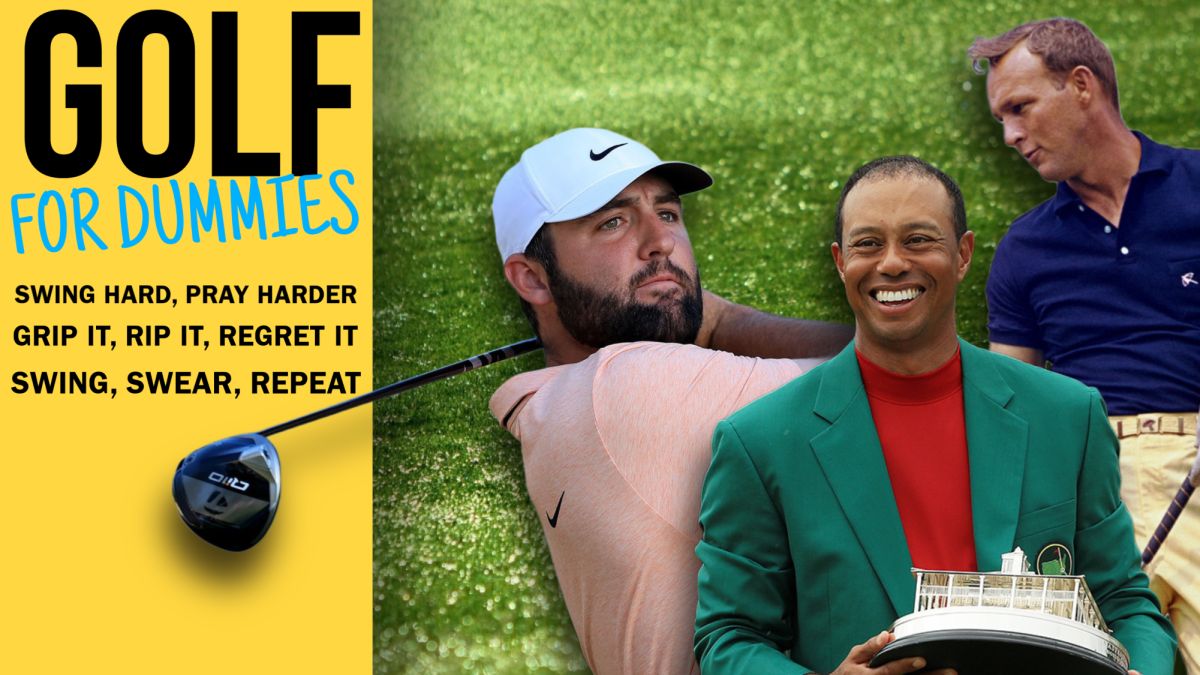
Sports for Dummies is back, and we’re taking a break from all the sports where people get knocked around. Instead, we’re focused on a sport that’s all about patience, aim and trying not to snap a club in half when the ball refuses to listen—golf.
So, put on a polo, grab those clubs and let’s go in on a nice, calm round of golf terminology.
Golf tends to attract an older male audience, which is why viewership peaks around 2-5 p.m. There’s just something about watching people in collared shirts swing a club at a ball and attempt to put it in a hole within a certain number of hits. I don’t understand the appeal, because I’m a young man who is more attracted to violent sports like hockey and MMA, but hey, everyone has their own thing.
By definition, a par is the fundamental scoring system of golf; it is the number of strokes that an expert golfer is expected to take to get the ball in the hole. The term is usually followed by that number, which is why a par-3 typically takes expert golfers three swings to complete. But who determines the par? I’d assume that there are golfers who sink it in more, or fewer, shots.
Golf would be more interesting if it were just a race to see who got the ball into the hole first. Maybe that opinion is the reason why experts make the courses and I just write about it.
Personnel are another fundamental piece of the game; A common misinterpretation is that golf is a single-person game. Golfers tend to be too fancy to carry their own clubs, fill in divots they make from swinging too hard or hold themselves up mentally, so they pay another person to do it for them—a caddy.
Caddies are tasked with these responsibilities and more, to help golfers perform their best. I would make some smartass remark about how caddies are golfers without the skill, but life needs more caddies.
Imagine having someone by your side to help you through challenging professional moments. It’s like having a coach, but they are actually helping you instead of screaming, “Get your ass back on the line!”
Now, imagine the most remarkable feats in sports. Pitching a perfect game in baseball, scoring a hat-trick in soccer or getting a TKO in MMA. Golf’s version of this is called a hole-in-one, and it is as simple as it sounds: you tee up your shot and swing the club as hard as you can. The ball soars over the fairway, lands on the green and goes straight into the cup. You and your friends all go absolutely crazy because, for casual players, the odds of hitting a hole-in-one are about 12,000 to one.
Finally, let’s discuss the concept “play it where it lies.” No matter where your ball lands, you must play it. However, there are exceptions. If you just shot your ball right into the lake, that’s good news for you; no need to dive in and find it. If you’ve managed to pin the ball under a tree and it’s still hittable, well, buckle up—that’s a playable ball.
I have no clue if golf will continue to grow or decline in popularity because I don’t pay enough attention to it, but with youngsters such as Rory McIlroy and Scottie Scheffler in their prime the future is easily secured.